TINA’S REQUEST
The devil is always in the details

Last year I was taken aback when my friend, Tina, asked, “When my time comes, what do you think of MAiD for me?” On one hand, as the patient, she could choose whatever treatment she wished, but as her chosen person for medical decision-making in an incapacitated state, I hesitated before answering.
My hesitation wasn’t because she would not qualify, as she was dying from advanced lung cancer. It had to do with a report about the drugs used for euthanasia1 and how this may not result in a painless and dignified death that pro-MAiD advocates claim.
MAiD (Medical assistance in dying) was legalized in Canada in 2016. It allows patients with painful conditions whose death was “reasonably foreseeable” to terminate their lives either by self-administration of fatal oral medications (assisted suicide) or physician administration of fatal medications (euthanasia).2 At the time, both methods were available in some European countries and US states.3 The estimated number of suitable patients was low. Since then, the indications for MAiD have expanded to include patients with a terminal illness where death was no longer “reasonably forseeable”.2 Widening the indications has led to a rapid growth of euthanasia. Currently, MAiD is the 4thleading cause of death in Canada. In 2024, 16,499 Canadians died from MAiD.4 In addition, as some MAiD patients have requested to donate their organs after death, this has led to a dramatic increase in organ donation.5
In Tina’s case, my reticence revolved around a disturbing article regarding autopsy findings in over 200 prisoners executed in the United States. The medications used to execute prisoners were the same classes used for MAiD. The article1 featured the observations of an experienced anaesthesiologist, Dr. Joel Zivot, who was born in Winnipeg and trained at the University of Toronto. Now, at Emory University, he was called to investigate whether a known anesthetic drug, sodium thiopental, given at the time of execution was adequate based on blood levels from recently executed prisoners at the time of their autopsy. In 43% of the executed prisoners, the serum levels of the drug were below the threshold required for surgical anesthesia, i.e. the levels were too low.1
More disturbingly, by weighing the lungs from each autopsy, the study found that 83% of the executed prisoners had pulmonary edema, or excess water in the lungs, compared to an expected lung weight. Some prisoner’s lungs were twice the expected weight, and there were descriptions of froth leaking from prisoners’ noses and mouths while dying. The cause of this was unclear because all the medications used for executing prisoners were the same as for general anesthesia. The exceptions were the extremely high dosages used, the combinations of the drugs, and how quickly the drugs were given.1
These drugs had been studied therapeutically to induce surgical anesthesia but never studied in such large doses that would result in death. Based on this, the reason for most prisoners to have pulmonary congestion at the time of death was unknown. Zivot speculated that it may be due to either a single drug, or the combination of drugs all given in extremely high dosages. The discovery of this unexpected finding suggested that just before dying, some prisoners would experience suffocation from drowning,1 akin to waterboarding.
The drugs used for both execution and MAiD are a combination of sedatives, anesthetics, paralytics, and cardiotoxic drugs. Typically, they are given sequentially. The most common sedative is the benzodiazepine, midazolam; related to well-known Valium, it is short acting and given to reduce anxiety. It does not reduce pain and when given in large doses, results in sedation.1
Anesthetic drugs induce anesthesia, a state of unconsciousness, where involuntary reflexes are absent and breathing becomes very shallow or stops.6 For execution, the most common anesthetic drug was a barbiturate, such as sodium thiopental, before they became unavailable as the drug manufacturer refused to make it for further executions. Subsequent executions and MAiD cases have used the anesthetic, propofol.7 In very large doses, propofol causes cardiovascular collapse causing death due to shock as well as flash pulmonary edema.8
Paralytics are used to completely block all muscle contraction except for the heart and intestines. This is given to prevent or stop twitching and involuntary movements that can occur during the agonal phase of death. Since the diaphragm is paralyzed, the patient cannot breathe spontaneously if the anesthetic drug has worn off. As the patient is no longer breathing or moving, some may regard the external appearance as calm and dignified.9 Paralytic drugs given for execution was pancuronium, while for MAiD a more modern form of this drug, rocuronium, is given.
Cardiotoxic drugs either stop heart contractions or induce irregular beating of the heart rendering it ineffective to pump blood. Potassium chloride (KCl) is the classic example of the former while the local anesthetic, bupivacaine, given in excessively high doses is an example of the latter. For execution, KCl was the cardiotoxic of choice while both drugs are used as cardiotoxics for MAiD.
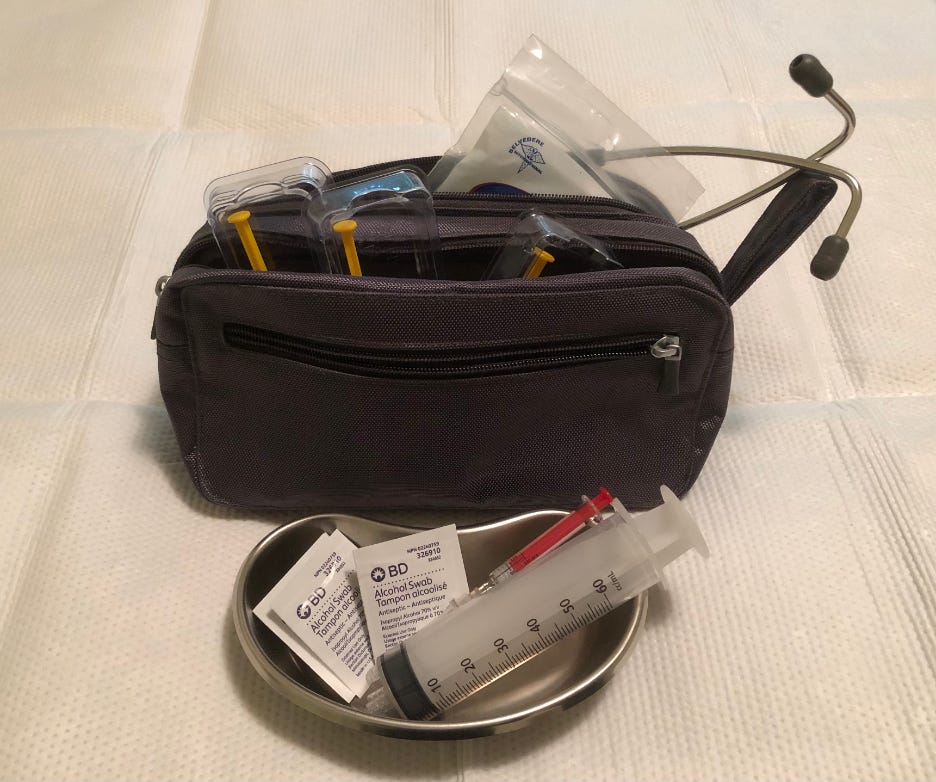
For the MAiD procedure,10 two large bore intravenous (IV) are inserted (one in each arm), in case a backup is required. The patient is not monitored nor given oxygen. The drugs are available as kits and given in the above sequence until death is determined clinically – no response, no breathing, and no heart sounds. This is not equivalent to brain death since there is no monitoring of brain wave activity.11
In a 2022 study of the MAiD drugs used in 3,557 cases from Ontario and B.C., the authors found using medications in the above order, the average time to die was 9 minutes.10
Not all patients, however, received the drugs available in the MAiD kit. Most (91%) received midazolam 10mg (a therapeutic dose would be ~ 1-2mg), the anesthetic drug propofol (99%) at 1000mg (a therapeutic dose would be ~ 200mg), and 98% received a paralytic drug, most commonly rocuronium at 200mg (a therapeutic dose is ~ 50mg).10
The only analgesic (pain killer) given to most patients (82%) was lidocaine, a local anesthetic drug occasionally also used to treat irregular heart rhythms. In this case, lidocaine was not used for local anesthesia but given IV prior to the anesthetic propofol, to prevent a burning sensation in the veins when propofol was injected.10
Only 0.6% (i.e. virtually none) of the patients received opiate medications, the most commonly prescribed class of drug for pain control.
Although the average time of death was 9 minutes, the range was from 1 to 127 minutes. In fact, 991 of the 3,557 (28%) patients took more than 1 hour to die.10
Cardiotoxic drugs, either KCl or bupivacaine, were used in a minority (24%, or 863) of patients who underwent MAiD.10 Given that 991 patients took more than one hour to die, the reason for not using cardiotoxic drugs to hasten death is surprising.
The drugs used for MAiD are prescribed daily by a small group of highly trained physicians, namely anesthesiologists, critical care doctors and emergency room doctors. However, in the above study, this group of doctors represented only 21% of the healthcare providers that administered MAiD.10
Overall, the complication rate from MAiD was low (1.3%), primarily due to loss of IV access, or need for a second kit.10 Death beyond 1 hour was not considered to be a complication.
Dr. Zivo remains concerned that although the anaesthetic agent used in MAiD, propofol, is different from the barbiturates pentobarbital and sodium thiopental used for prisoner executions, it may still cause pulmonary edema when used in large dosages. Zivo believes the only way to address this is to perform autopsies on people given high doses of propofol.12
However, proponents of MAiD cite a 2022 paper from the University of Toronto describing the results of lung transplantation outcomes from MAiD donors; this study showed that the operative death rate and intermediate lung function outcomes of 33 sets of lungs from MAiD donors were no different than historical donors from other sources.13
Still, the devil is in the details. In the paper, MAiD patients were brought to the operating room after death was clinically confirmed and their lungs quickly removed and flushed with a perfusing solution. Lungs were then grossly inspected. If the assessment was questionable, the lungs were attached to a lung perfusion protocol. Of the original 38 MAiD donors, 13 passed the gross inspection. Of the remaining 25 lungs, these were attached to a lung perfusion system and then re-evaluated; 6 of 25 (24%) were rejected because of pulmonary edema.13
[Author’s note: these numbers are directly from the paper. Readers may have spotted that there were in fact 32 lung grafts studied and compared with historical controls, not 33.]
So, the issue of pulmonary edema following administration of large doses of propofol remains unresolved. The question as to why one quarter of MAiD deaths took more than an hour, while cardiotoxic agents were only given in one quarter of patients and narcotics were virtually never given raises questions as to what is happening during the dying process. As propofol wears off quickly, giving a large dose of paralytic agent to mask any external twitching movement may also prevent any ability by the patient to breathe should they be waking up.
Since there is no monitoring of brain waves, it is possible that the last memory of a patient dying by MAiD may be the panicked sensation of drowning and inability to breathe while their pain remains. If this scenario is possible, Zivo’s suggestion of an autopsy study of MAiD patients will help resolve this issue.
In Tina’s case, I explained to her that death should be pain and worry free. As MAiD is a new procedure and the question of what may be happening despite claims of a painless and dignified death, I recommended palliative care. When her time came, the palliative care team was great and administered narcotic analgesics to eliminate anxiety and pain. After struggling with pain for weeks, she quickly fell into a deep restful sleep from which she did not wake up.
RIP, Tina.
REFERENCES
1. Caldwell N, Chang A, Myers J. Gasping for Air: Autopsy reveal troubling effects of lethal injections. NPR Sept. 21, 2020. https://www.npr.org/2020/09/21/793177589/gasping-for-air-autopsies-reveal-troubling-effects-of-lethal-injection
2. Government of Canada. Final report of the expert panel on MAiD and mental illness. https://www.canada.ca/en/health-canada/corporate/about-health-canada/public-engagement/external-advisory-bodies/expert-panel-maid-mental-illness/final-report-expert-panel-maid-mental-illness.html
3. Green K. Canada’s MAiD program is the fastest growing in the world, now represents over 4 percent of all deaths. The Hub. Sept. 13, 2024. https://thehub.ca/2024/09/13/canadas-maid-program-is-the-fastest-growing-in-the-world-today-making-over-4-of-all-deaths/
4. Carpay J. Canada needs to urgently provide life-affirming responses to end-of-life suffering. The Epoch Times. Jan. 24, 2026. https://www.jccf.ca/epoch-times-canada-needs-to-urgently-provide-life-affirming-responses-to-end-of-life-suffering/
5. Hendricks GL. Canada is turning its assisted suicide regime (MAiD) into an organ donation supply chain. Real Truth Real News. Oct. 2, 2025.

6. Siddiqui BA, Kim PY. Anesthesia stages. StatPearls. Jan. 29, 2023. https://www.ncbi.nlm.nih.gov/books/NBK557596/
7. Propofol Dosage. Drugs.com. Nov. 24, 2025. https://www.drugs.com/dosage/propofol.html
8. Camus P. The drug-induced respiratory disease website. https://www.pneumotox.com/drug/index/?page=52
9. Death Penalty Information Centre. Dec. 2020. https://deathpenaltyinfo.org/resources/podcasts/discussions-with-dpic/anesthesiologist-dr-joel-zivot-on-what-prisoner-autopsies-tell-us-about-lethal-injection
10. Stukalin I, Oluwatobi RO, Nalik V, et. al. Medications and dosages used in medical assistance in dying; A cross-sectional study. Can Med Assoc J 2022;10:E19-26. https://www.cmajopen.ca/content/10/1/E19
11. What is clinical death? A medical and scientific explanation. https://biologyinsights.com/what-is-clinical-death-a-medical-and-scientific-definition/
12. Kirkey S. How can doctors be sure a medically assisted death is a ‘peaceful’ death? National Post. Jul 1, 2022. https://nationalpost.com/news/canada/medical-assistance-in-dying-how-do-people-die-from-maid
13. Watanabe T, Kiwashima M, Kohno M, et. al. Outocmes of lung trsansplantation from organ donation after medical assistance in dying: First North American experience. Am J Transplant. 2022;22:1637–1645. https://onlinelibrary.wiley.com/doi/abs/10.1111/ajt.16971
Accompanies an outstanding interview!
Have followed Dr Joel Zivot's precautionary warnings regarding potential concerns with MAiD in 🇨🇦 for over 2 years. Dr Hsiang adds volumes
Great article, York. A couple of questions: Is it true that when a person dies under MAID, that only the the illness, or disability leading to the request for MAID is permitted to be recorded as the cause of death, and no reference to MAID or the drugs administered are permitted to be listed? I think this is true of Ontario, but do you know if it is true in BC as well? Any theories as to why they don’t want any reference to MAID on the death certificate?